Smithsonian/USGS Weekly Volcanic Activity Report 28 March to 3 April 2012 5 April 2012
Posted by admin in activity reports, Alaska, Caribbean, Chile, Cleveland, Colombia, Ecuador, Etna, Fuego, Guatemala, Hawaii, Iliamna, Indonesia, Italy, Kamchatka, Karymsky, Kilauea, Lewotobi, Mexico, Nevado del Ruiz, Popocatépetl, Puyehue, Russia, Shiveluch, Soufrière Hills, Sundoro, Tengger Caldera, Tungurahua, United States, Weekly Volcanic Activity Reports.Tags: Global Volcanism Program
comments closed
The latest Smithsonian Institution and United States Geological Survey Weekly Volcanic Activity Report has been published by the Global Volcanism Program, covering the week 28 March to 3 April 2012. The report is compiled by Sally Kuhn Sennert. Among the highlights of this week:
- Alert level at Clevelandraised as a new lava dome becomes evident
- A significant increase in seismicity at Nevado del Ruiz brings a rise in the alert level
- High levels of sulphur dioxide emissions at Soufrière Hills
- Another paroxysmal eruptive episode at Etna with lava fountaining and ashfall

Click on the map for a larger version (1211 x 784 pixels).
The Smithsonian Institution/United States Geological Survey Weekly Volcanic Activity Report for 28 March to 3 April 2012 is now available on the Global Volcanism Program website. The following is a summary and not a substitute for the full report.
- The current report: Weekly Volcanic Activity Report.
- Previous reports: Weekly Reports Archive.
- The SI/USGS map of volcanoes discussed this week.
New activity/unrest: Cleveland (Alaska, USA), Fuego (Guatemala), Iliamna (Alaska, USA), Lewotobi (Indonesia), Nevado del Ruiz (Colombia), Soufrière Hills (Montserrat), Sundoro (Indonesia).
Ongoing activity: Etna (Italy), Karymsky (Russia), Kilauea (Hawaii, USA), Popocatépetl (Mexico), Puyehue-Cordón Caulle (Chile), Shiveluch (Russia), Tengger Caldera (Indonesia), Tungurahua (Ecuador).
Note: ‘a.s.l.’ = ‘above sea level’.
Whoops, holiday 2 April 2012
Posted by admin in admin.comments closed
Never post in a hurry: not with WordPress, anyway, which on (rare) occasions will take a post you think you have just published and treat it as a draft, so that it never actually appears.* That’s what happened to my holiday announcement on 18 March, which said that I would be away for two weeks. Sorry about that: the impression inadvertently created of an unexplained disappearance is most unfortunate and somewhat discourteous. I’ll be away from blogging again over the Easter weekend, so I have some catching up to do between now and then.
* The other possibility, of course, is that I did something wrong. If it was a glitch, I should say that it really hardly ever happens, and I am very happy with WordPress as a rule.

Smithsonian/USGS Weekly Volcanic Activity Report 14-20 March 2012 22 March 2012
Posted by admin in activity reports, Caribbean, Chile, Cleveland, Colombia, Ecuador, Etna, Hawaii, Iliamna, Italy, Japan, Kamchatka, Karymsky, Kilauea, Kizimen, Mexico, Nevado del Ruiz, Popocatépetl, Puyehue, Russia, Sakura-jima, Shishaldin, Soufrière Hills, Tungurahua, United States, Villarrica, Weekly Volcanic Activity Reports.Tags: Global Volcanism Program
comments closed
The latest Smithsonian Institution and United States Geological Survey Weekly Volcanic Activity Report has been published by the Global Volcanism Program, covering the week 14-20 March 2012. The report is compiled by Sally Kuhn Sennert. Among the highlights of this week:
- A plume, probably water vapour, seen from Iliamna, where seismicity remained elevated
- Seismicity decreased at Nevado del Ruiz but significant gas emissions continued
- Etna continued lively with lava flows and fountaining, and strong ash emission
- Daily explosions at Shiveluch produced plumes which reached 3-5 km altitude

Click on the map for a larger version (1211 x 784 pixels).
The Smithsonian Institution/United States Geological Survey Weekly Volcanic Activity Report for 14-20 March 2012 is now available on the Global Volcanism Program website. The following is a summary and not a substitute for the full report.
- The current report: Weekly Volcanic Activity Report.
- Previous reports: Weekly Reports Archive.
- The SI/USGS map of volcanoes discussed this week.
New activity/unrest: Iliamna (Alaska, USA), Nevado del Ruiz (Colombia).
Ongoing activity: Cleveland (Alaska, USA), Etna (Italy), Karymsky (Russia), Kilauea (Hawaii, USA), Kizimen (Russia), Popocatépetl (Mexico, Puyehue-Cordón Caulle (Chile), Sakura-jima (Japan), Shiveluch (Russia), Soufrière Hills (Montserrat), Tungurahua (Ecuador), Villarrica (Chile).
Note: ‘a.s.l.’ = ‘above sea level’.
Kilauea to star in BBC ‘Volcano Live’ series in July 16 March 2012
Posted by admin in Kilauea, media, volcano culture.Tags: BBC, volcanoes in the media
comments closed
The BBC likes to do big-budget live TV specials from time to time: they are of course very expensive and complicated, so the corporation has to choose its favoured subjects very carefully. Recently we’ve had natural history (Springwatch), astronomy (Stargazing), and little baby lambs (Lambing Live). The next big live BBC TV subject is a really big one: volcanoes. ‘BBC Two have decided to expand their unique broadcasting technique of commissioning live events with a Volcano Live series’ claims a remarkably illiterate and typo-ridden report at imediamonkey, making it seem that the BBC is actually going to go out there and commission a volcanic eruption. In fact BBC Two is taking the more sensible course of setting up the programme around a volcano that is already erupting, and which erupts in a reasonably predictable and safe way: Hawaii’s Kilauea.
The series will be broadcast in four parts from 9 to 12 July and will combine live reports from Kilauea with segments looking at the phenomenon of volcanism and exploring volcanoes around the world. Professor Iain Stewart (British television’s Mr Geology) and Kate Humble (British television’s Ms Natural History) will do the presenting. According to BBC Two controller Jane Hadlow, ‘Volcano Live will offer BBC Two viewers a rare opportunity to join world-class experts at the forefront of cutting-edge volcanology research. Broadcasting live from the edge of one of the world’s most active volcanoes over four days will offer a completely new and unique way of experiencing this powerful and unpredictable natural phenomenon’.
This is a high-profile project by the BBC which, if it puts the science in the foreground, has the potential to do a great deal for the public understanding of volcanoes and volcanology. Let’s hope it fulfils that potential. Let’s also hope that Kilauea doesn’t decide to end its current long-running eruption before the cameras arrive in July. That would be annoying.
News
BBC Two announces Volcano Live – BBC Two press release, 16 March 2012
BBC Two announces its latest live event series Volcano Live – Televisual, 16 March 2012 (BBC press release recycled)
BBC Two to broadcast live from active volcano – imediamonkey, 16 March 2012 (BBC press release recycled, with added gibberish)
Smithsonian/USGS Weekly Volcanic Activity Report 7-13 March 2012 15 March 2012
Posted by admin in activity reports, Alaska, Bezymianny, Chile, Cleveland, Colombia, eruptions, Hawaii, Ijen, Iliamna, Indonesia, Japan, Kamchatka, Karymsky, Kilauea, Kizimen, Lamongan, Marapi, Nevado del Ruiz, Puyehue, Russia, Sakura-jima, Santa María, Shiveluch, Tungurahua, United States, Villarrica, Weekly Volcanic Activity Reports.Tags: Global Volcanism Program
comments closed
The latest Smithsonian Institution and United States Geological Survey Weekly Volcanic Activity Report has been published by the Global Volcanism Program, covering the week 7-13 March 2012. The report is compiled by Sally Kuhn Sennert. Some of the news from a week that has seen quite a lot of new activity:
- An explosive eruption at Bezymianny sent ash up to 8 km altitude
- Activity at Nevado del Ruiz marked by explosions, ash emissions and increased seismicity
- Cleveland stirs with small explosive eruptions
- Explosions at Santa María produce localized ashfall

Click on the map for a larger version (1211 x 784 pixels).
The Smithsonian Institution/United States Geological Survey Weekly Volcanic Activity Report for 7-13 March 2012 is now available on the Global Volcanism Program website. The following is a summary and not a substitute for the full report.
- The current report: Weekly Volcanic Activity Report.
- Previous reports: Weekly Reports Archive.
- The SI/USGS map of volcanoes discussed this week.
New activity/unrest: Bezymianny (Russia), Cleveland (Alaska, USA), Ijen (Indonesia), Iliamna (Alaska, USA), Lamongan (Indonesia), Marapi (Indonesia), Nevado del Ruiz (Colombia), Tungurahua (Ecuador).
Ongoing activity: Karymsky (Russia), Kilauea (Hawaii, USA), Kizimen (Russia), Puyehue-Cordón Caulle (Chile), Sakura-jima (Japan), Santa María (Guatemala), Shiveluch (Russia), Villarrica (Chile).
Note: ‘a.s.l.’ = ‘above sea level’.
Cleveland, Alaska: another small explosion 15 March 2012
Posted by admin in activity reports, Alaska, Cleveland, eruptions, Iliamna, United States.comments closed
Cleveland volcano in the Aleutians had another small eruption on the afternoon of 13 March, reports the Alaska Volcano Observatory, the third such event in a week (the previous eruptions were on 7 March and 10 March). The AVO status report, issued on 14 March at 1134 local time (1934Z) describes what happened:
Yesterday afternoon at approximately 2:55 pm AKDT (22:55 UTC), AVO infrasound and seismic networks detected a small explosion at Cleveland. Clouds prevented a clear view of the volcano at the time of the explosion, however, ash was not observed rising through the cloud deck suggesting relatively minor ash emission.
The Volcano Alert Level for Cleveland remains at Watch, the Aviation Colour Code at Orange. The same report notes that seismicity remains elevated at Iliamna volcano (which remains at Yellow/Advisory).
News
Cleveland volcano explodes for the third time – alaskapublic.org, 14 March 2012
Information
Global Volcanism Program: Cleveland – summary information for Cleveland (1101-24-)
Global Volcanism Program: Iliamna – summary information for Iliamna (1103-02-)
AVO Cleveland Activity Page – information on current activity at Cleveland
AVO Iliamna Activity Page – information on current activity at Iliamna
Alaska Volcano Observatory – AVO main page
The Daily Volcano Quote: a narrow escape at Santorini 14 March 2012
Posted by admin in daily volcano quote.comments closed
 Dr. Schmidt happened, with his colleagues, to be on the summit of Nea Kameni when a fearful thundering eruption of stones and ashes began, which lasted from two to three minutes. Leaving their instruments behind them they fled to the N.W., seeking as far as they could to shelter themselves from the shower of red-hot stones. They were all more or less hurt and burnt. The steamer Aphroessa was struck heavily by a shower of stones; the deck was stove in, only one yard from the powder-magazine, and the engineer’s cabin was set on fire. At the mole lay a vessel, which was instantly set on fire by the stones and her captain killed on the spot by a falling block. Many of the sailors of the Aphroessa were hurt; but only one, a petty officer, seriously wounded. After the explosion the steamer changed her anchorage, and landed her powder for fear of further accidents.
‘Papers relating to the recent volcanic eruptions in Santorin’, Proceedings of the Royal Geographical Society of London, vol. 10, no. 3 (12 March 1866), pp. 119-20. Dr Johann Friedrich Julius Schmidt was Director of the Royal Observatory at Athens from 1858 to 1884, and had travelled with his colleagues on the Aphroessa to Santorini (called here ‘Santorin’) to observe and study the 1866 eruption.
The Daily Volcano Quote: from Monday to Friday, a new eruption of volcanic verbiage each day.
Santorini shows signs of restlessness 14 March 2012
Posted by admin in activity reports, Greece, Santorini.comments closed
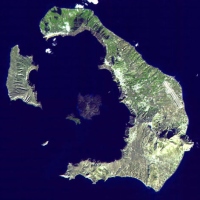 The almost unbelievable beauty and visual drama of the Greek island group known as Santorini in the southern Aegean Sea is the result of a complex geological history. Santorini is the site of several shield volcanoes which overlap and are cut by a number of calderas created by successive very large explosive eruptions (180,000 years ago, 70,000 years ago, 21,000 years ago and 3,600 years ago). The most recent large eruption around 1650 BC was one of the most powerful of Holocene volcanic eruptions, with a VEI normally rated as 6 or 7. This eruption has been associated with the destruction of the Minoan civilization in nearby Crete, and certainly had a destructive impact across an extensive area of the eastern Mediterranean. Since that most recent caldera collapse event Santorini has periodically reminded everyone that it is still active, with smaller-scale (but locally destructive) eruptions in 1570, 1650, 1707 and 1866, generally involving submarine activity with dome extrusion, island formation, lava flows and phreatic explosions. During the twentieth century there was activity in 1925, 1928, 1939 and 1950. The site of recent activity has been Nea Kameni, which can be seen in the centre of the island group in the image above, which dates from 21 November 2000 and comes from the NASA Earth Observatory.
Santorini, then, is very much an active volcano, and there are currently indications that it is becoming restless once again. A team led by Dr Andrew Newman of Georgia Tech has been monitoring Santorini through a dense network of GPS stations since 2006. Over the past year, since January 2011, these instruments have detected a reawakening of the volcano. Newman’s team has published their observations in Geophysical Research Letters (papers in press). To quote from the abstract:
After approximately 60 years of seismic quiescence within Santorini caldera, in January 2011 the volcano reawakened with a significant seismic swarm and rapidly expanding radial deformation. The deformation is imaged by a dense network of 19 survey and 5 continuous GPS stations, showing that as of 21 January 2012, the volcano has extended laterally from a point inside the northern segment of the caldera by about 140 mm and is expanding at 180 mm/yr. A series of spherical source models show the source is not migrating significantly, but remains about 4 km depth and has expanded by 14 million m3 since inflation began.
An injection of fresh magma is clearly going on at depth. This may not produce eruptive activity at the surface at all (Professor Newman points out that other calderas around the world have shown comparable activity without erupting), but Santorini, a volcano with the potential to be very dangerous, is evidently getting restless once again.
- A. V. V. Newman, S. Stiros, L. Feng, P. Psimoulis, F. Moschas, V. Saltogianni, Y. Jiang, C. Papazachos, D. G. Panagiotopoulos, E. Karagianni, & D. Vamvakaris, ‘Recent geodetic unrest at Santorini Caldera, Greece’, Geophysical Research Letters, doi:10.1029/2012GL051286, in press (accepted 6 March 2012). [abstract]
News
Santorini: the ground is moving again in paradise – Georgia Tech news release, 13 March 2012 (duly recycled at ScienceDaily, esciencenews and probably elsewhere too)
Volcanic island of Santorini shows activity – Greek Reporter, 13 March 2012
Volcanic activity detected on Greek island – TG Daily, 14 March 2012
Volcano on scenic Greek island getting a little restless – msnbc.com, 14 March 2012
Greek volcano reawakens – ScienceNews, 14 March 2012
Information
Global Volcanism Program: Santorini – GVP information for Santorini (0102-04=)
ISMOSAV – Institute for the Study and Monitoring of the Santorini Volcano
Santorini Decade Volcano – Santorini profile from the Decade Volcanoes project
Alert level raised at Ijen, Indonesia 13 March 2012
Posted by admin in activity reports, Ijen, Indonesia.comments closed
VolcanoDiscovery reports that the alert level for Ijen volcano in eastern Java, Indonesia, has been raised to level 3, ‘alert’ (the second-highest level) because of an increase in activity. Ijen’s alert level was last raised to 3 in December 2011, but was lowered to 2 in February. Concern about increased seismicity and degassing led Indonesia’s geological and hazard mitigation authority, PVMBG, to raise the level to 3 again on 12 March.
[H/T: VolcanoDiscovery.]
Information
Global Volcanism Program: Ijen – summary information for Ijen (0603-35=)
Sakura-jima: eruptive activity increases 13 March 2012
Posted by admin in activity reports, eruptions, Japan, Sakura-jima.comments closed
Situated in the south of Kyushu, the southernmost of the four main islands making up the Japanese archipelago, Sakura-jima is one of the world’s most active volcanoes. The Global Volcanism Program records Sakura-jima’s current eruption as having begun in October 1955, so it has now been on the go continuously for more than half a century.
Over the past couple of weeks Sakura-jima has shown an increase in the level of its activity, with ash explosions increasing in size and frequency. Yesterday there was a sizeable explosion which the Japan Meteorological Agency classed as the most powerful since 2009 (‘Foot-wide rocks were expulsed over a mile away’ reports the Daily Telegraph, incoherent with excitement), and today the activity has continued with violent explosions, lava fountaining, and pyroclastic material being ‘expulsed’ up to 2 km altitude.
News
Volcano erupts violently in Japan – Daily Telegraph, 13 March 2012 (video)
Moment volcano erupted in Japan – BBC News, 13 March 2012 (video)
Information
Global Volcanism Program: Sakura-jima – summary information for Sakura-jima (0802-08=)









 The Volcanism Blog